AI interactions and generated or manipulated content require a case-specific assessment of the relevant Article 50 pathway, organisational role, missing evidence and implementation approval.
KI PraxisPilot · EU AI Act · Article 50
Label AI Content & AI Interactions – EU AI Act Practice Kit
Assess when Article 50 transparency duties are relevant to your AI interaction or content case, prepare the appropriate information, disclosure or labelling measure, and document implementation, approval and evidence in a traceable way.
Implement more efficiently & reduce setup effortStart directly with a prepared Article 50 assessment and evidence structure — less time spent turning legal requirements into your own workflow.
- Assess the concrete case record the AI use, role, channel, content type and relevant transparency pathway.
- Prepare the right measure distinguish user information, visible disclosure/labelling and machine-readable marking instead of treating them as one generic label.
- Document approval & evidence preserve provider evidence, implementation records, human review where relevant, release approval and reassessment triggers.
7 editable work tools1 Transparency Cockpit1 guided Navigator1 AI assistant
Product at a glance
EU AI Act Article 50 transparency work for real AI interactions and content cases
The Practice Kit is a working and evidence system for organisations that need to assess transparency obligations for providers and deployers of certain AI systems under Article 50 of Regulation (EU) 2024/1689 (EU AI Act).
It supports concrete cases such as direct human interaction with AI systems, provider-side marking of synthetic outputs, emotion-recognition or biometric-categorisation use, deepfakes and certain AI-generated or AI-manipulated public-interest text. It helps you distinguish the relevant pathway, gather missing provider information, prepare the measure, document human/editorial review where relevant, approve the implementation and retain evidence for later reassessment.
Product typeDigital Practice Kit
How it worksGuided workflow + modular work tools
File formatsHTML · DOCX · XLSX · PDF · MD
Price€199.00 incl. VAT
ProviderSP Services GmbH
DeliveryDigital download
From the individual case to a documented work status
From an AI use case to a documented transparency decision
Create a documented case for each use or channel with scope, roles, transparency findings, the implemented notice or evidence, approval and change or reassessment status.
Separate the Article 50 pathways correctly
Do not collapse direct-interaction information, visible disclosure, labelling and provider-side machine-readable marking into one generic “AI label”.
Capture role and deployment facts before drafting notices
Record whether the organisation is acting as provider or deployer for the relevant system/use and preserve the facts that support the working assumption.
Close provider-evidence gaps explicitly
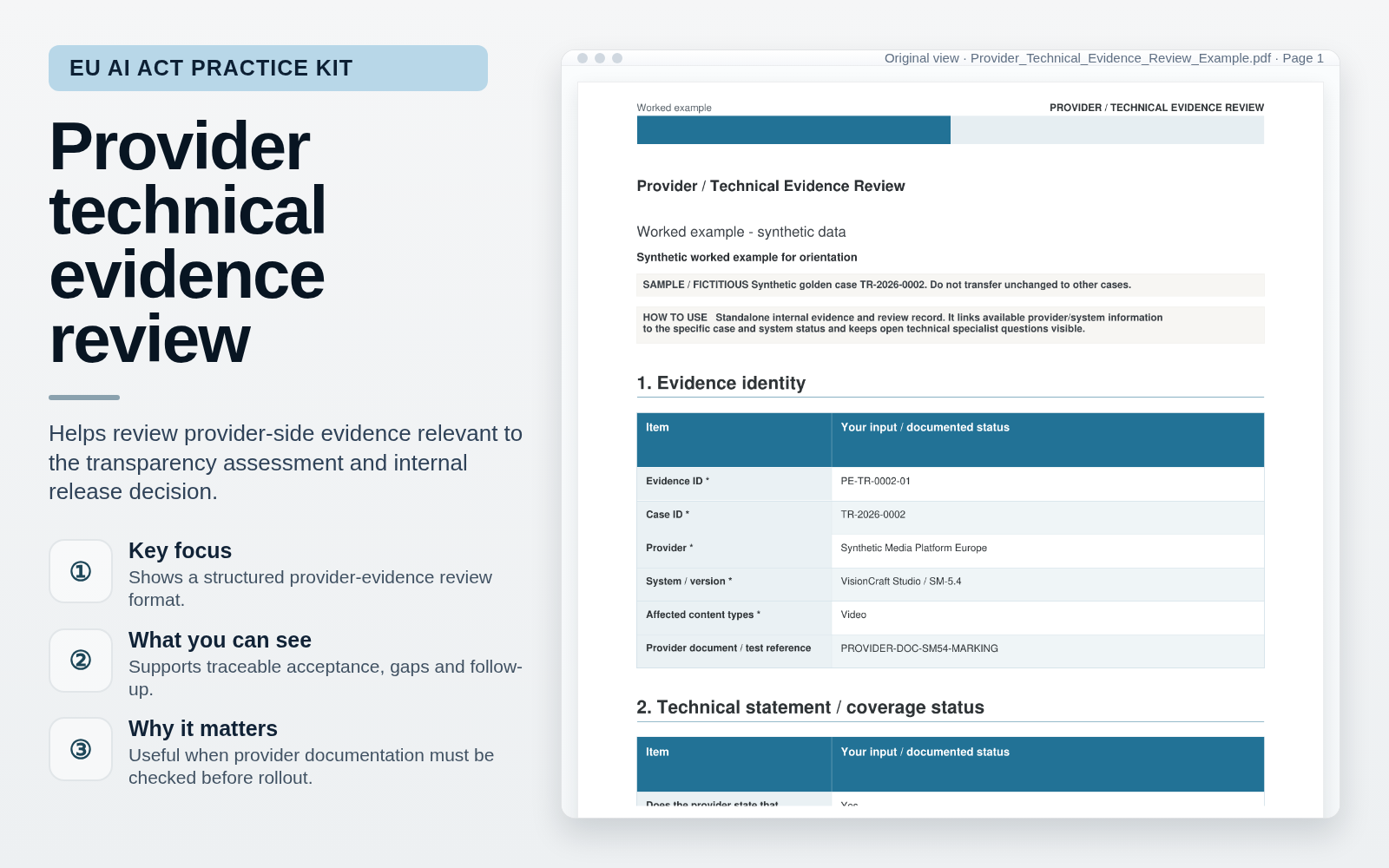
Use a dedicated evidence request and technical-evidence review instead of assuming that technical marking or model information exists and is sufficient.
Document implementation, review and approval
Connect the chosen transparency measure with implementation evidence, responsible owners, human/editorial review where relevant and release approval.
Keep specialist-review stops visible
Unclear roles, edge cases, sensitive uses, exceptions and technical-effectiveness questions remain explicit instead of being forced into an automated yes/no answer.
Reassess when the use changes
Use the change/reassessment record when system, channel, content type, audience, model behaviour, role or legal guidance changes.
Implement more efficiently
A prepared structure for your own implementation
Scope and role assessment, transparency pathways, provider evidence, human review, approval and reassessment form a prepared workflow for documenting an AI interaction or content case.
Reduce preparation effort
Prepared processes, work tools and evidence structures help reduce internal research and setup effort.
Use your internal expertise
Use your team's existing expertise within a structured working process.
Bring in specialist expertise where needed
Individual legal, privacy, technical and specialist questions remain with the responsible functions. External support can focus on questions that require an individual review or decision.
TASKS & REQUIREMENTS
Tasks & requirements
Is the AI use within the relevant AI Act scope?
EU AI Act Article 2 and the package's scope-routing logic.
Is the AI use within the relevant AI Act scope?
EU AI Act Article 2 and the package's scope-routing logic.Record the deployment context and route unresolved territorial, material or exception questions for specialist review.
Work tools: Transparency Navigator; Case Assessment / Decision / Evidence Record; Disclosure / Labelling Implementation Record
Outcome / evidence: A documented case status with responsibilities, open questions and evidence references.
Are we acting as provider or deployer for this case?
EU AI Act role definitions and the concrete facts of the deployment.
Are we acting as provider or deployer for this case?
EU AI Act role definitions and the concrete facts of the deployment.Document the working role assumption and the factual basis instead of translating roles loosely. Use provider and deployer consistently.
Work tools: Provider Evidence Request; Provider Technical Evidence Review
Outcome / evidence: A documented case status with responsibilities, open questions and evidence references.
Are people directly interacting with an AI system and do they need to be informed?
Article 50(1), subject to its conditions and exceptions.
Are people directly interacting with an AI system and do they need to be informed?
Article 50(1), subject to its conditions and exceptions.Assess the interaction channel, context and existing transparency and prepare an appropriate user-information measure where required.
Work tools: Transparency Navigator; Case Assessment / Decision / Evidence Record; Disclosure / Labelling Implementation Record
Outcome / evidence: A documented case status with responsibilities, open questions and evidence references.
Does provider-side machine-readable marking apply to synthetic output?
Article 50(2).
Does provider-side machine-readable marking apply to synthetic output?
Article 50(2).Review the provider-side technical marking pathway separately from visible user-facing disclosure and collect technical evidence for the selected implementation.
Work tools: Provider Evidence Request; Provider Technical Evidence Review
Outcome / evidence: A documented case status with responsibilities, open questions and evidence references.
Does the case involve emotion recognition or biometric categorisation?
Article 50(3).
Does the case involve emotion recognition or biometric categorisation?
Article 50(3).Document the deployment context, affected persons and applicable information duty and route sensitive/legal questions for specialist review.
Work tools: Transparency Navigator; Case Assessment / Decision / Evidence Record; Disclosure / Labelling Implementation Record
Outcome / evidence: A documented case status with responsibilities, open questions and evidence references.
Is the content a deepfake requiring disclosure?
Article 50(4).
Is the content a deepfake requiring disclosure?
Article 50(4).Assess the concrete content and context, prepare the disclosure/labelling approach and preserve the decision and implementation evidence.
Work tools: Transparency Navigator; Case Assessment / Decision / Evidence Record; Disclosure / Labelling Implementation Record
Outcome / evidence: A documented case status with responsibilities, open questions and evidence references.
Is AI-generated or manipulated text published to inform the public on matters of public interest?
Article 50(4).
Is AI-generated or manipulated text published to inform the public on matters of public interest?
Article 50(4).Assess the case and document any relevant human review/editorial responsibility pathway rather than assuming a blanket exemption.
Work tools: Transparency Navigator; Case Assessment / Decision / Evidence Record; Disclosure / Labelling Implementation Record
Outcome / evidence: A documented case status with responsibilities, open questions and evidence references.
Is the information provided at the right time and in an accessible manner?
Article 50(5).
Is the information provided at the right time and in an accessible manner?
Article 50(5).Include timing, placement and accessibility in the implementation and approval review.
Work tools: Transparency Navigator; Case Assessment / Decision / Evidence Record; Disclosure / Labelling Implementation Record
Outcome / evidence: A documented case status with responsibilities, open questions and evidence references.
Is an edge case, exception, law-enforcement context or technical-effectiveness question unresolved?
Practice Kit working method; no separate regulatory obligation.
Is an edge case, exception, law-enforcement context or technical-effectiveness question unresolved?
Practice Kit working method; no separate regulatory obligation.Route the case to specialist review. The Practice Kit is deliberately designed to stop automated closure where a defensible conclusion requires additional expertise or current official guidance.
Work tools: Transparency Navigator; Case Assessment / Decision / Evidence Record; Disclosure / Labelling Implementation Record
Outcome / evidence: A documented case status with responsibilities, open questions and evidence references.
Package contents
Guided Practice Kit and independently usable work tools
Follow the complete guided workflow or use individual work tools within your existing process.
Transparency Navigator
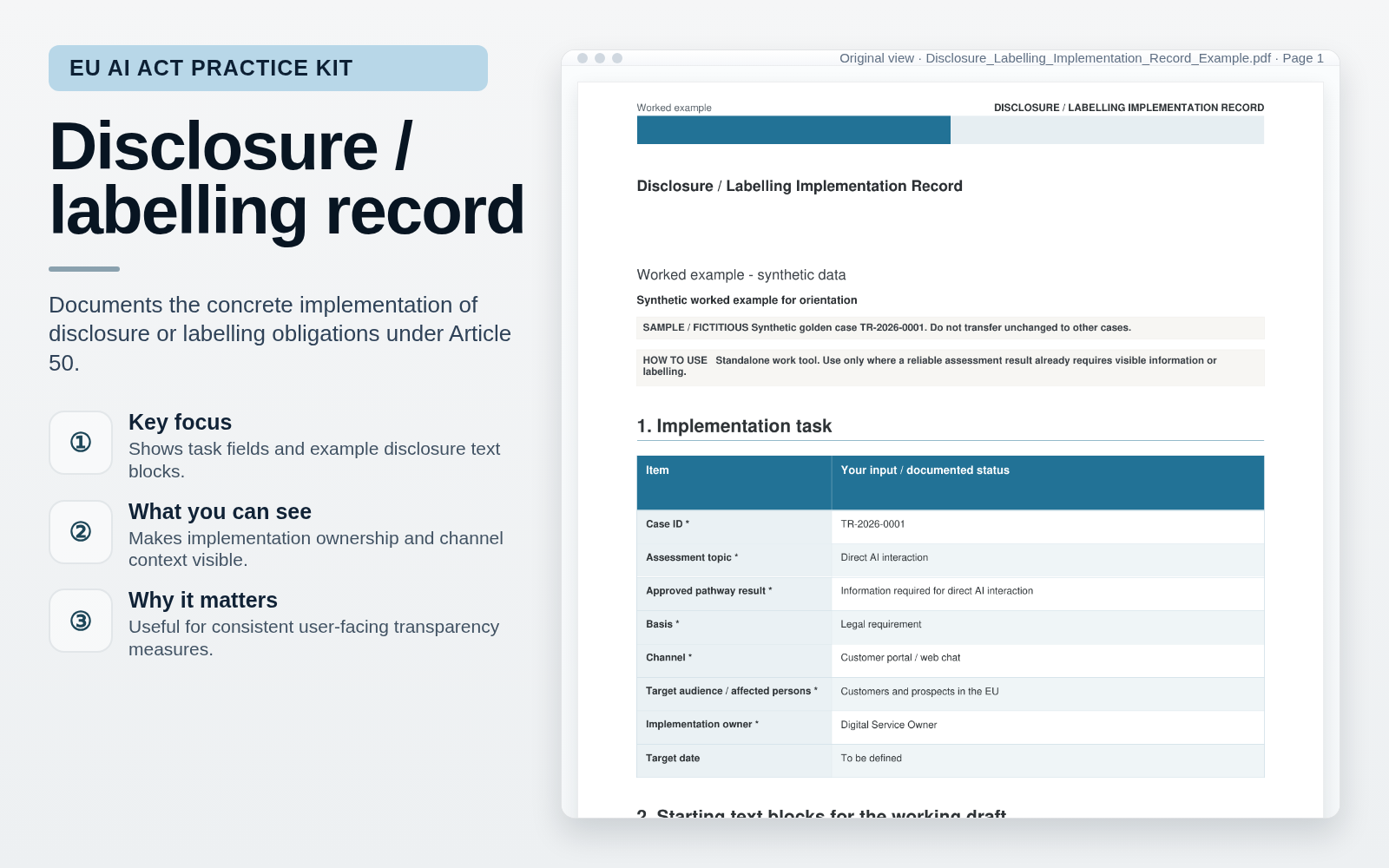
HTMLA guided browser-based path for recording the case, role/deployment facts, relevant Article 50 pathway and next working step.
EU AI Act Article 50 Implementation Checklist
XLSXAn Excel checklist for tracking requirement status, actions, responsibilities, evidence and closure.
7 editable Word work tools
DOCXCase Assessment / Decision / Evidence Record; Provider Evidence Request; Provider Technical Evidence Review; Disclosure / Labelling Implementation Record; Human Review / Editorial Responsibility Record; Approval / Release Record; Change / Reassessment Review Record
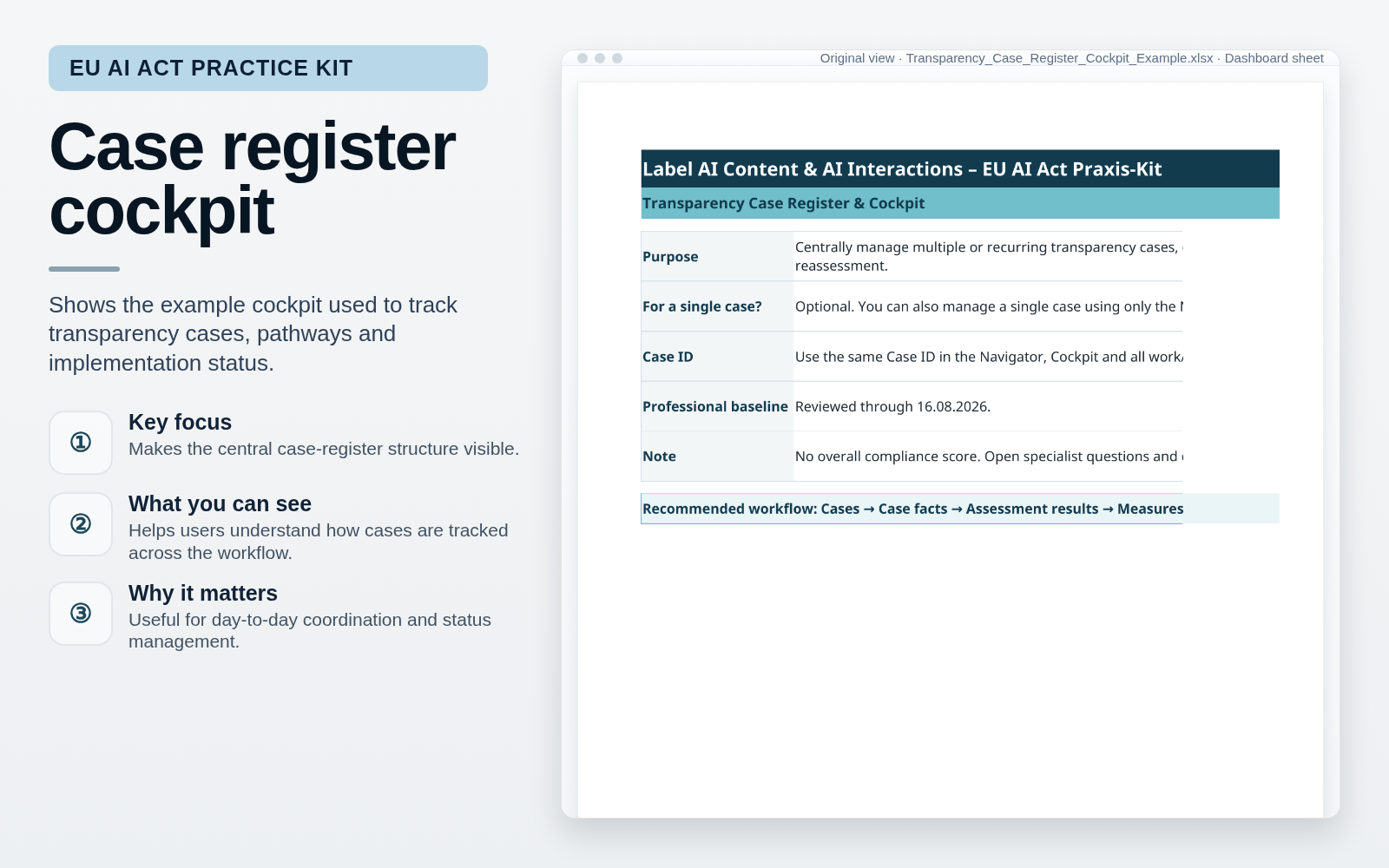
Transparency Case Register Cockpit
XLSXA central Excel register for multiple transparency cases and their status.
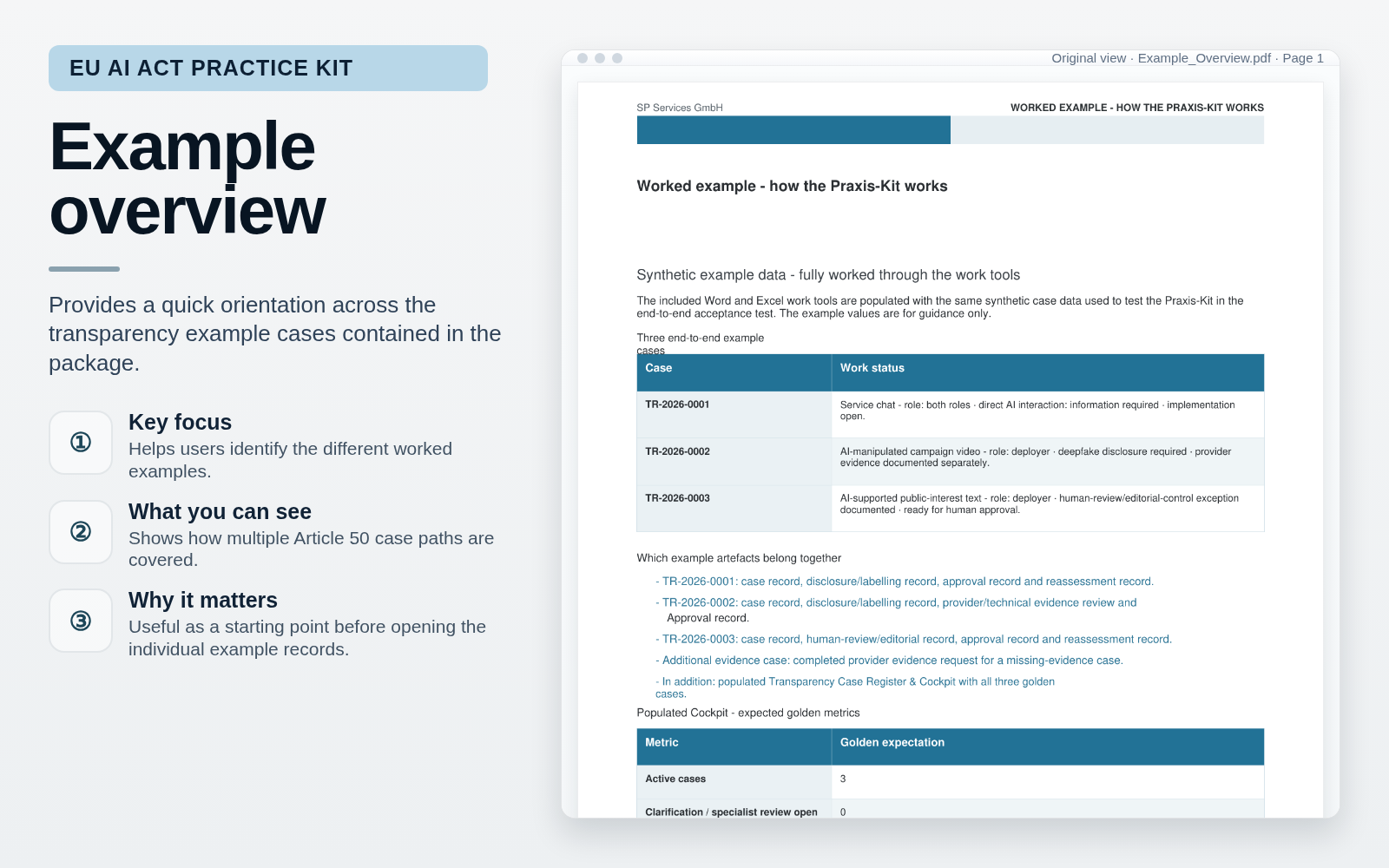
3 synthetic worked cases plus provider-evidence example
PDF · DOCX · XLSXWorked examples illustrate different Article 50 pathways without replacing the organisation's own assessment.
Article 50 guidance and requirements mapping
PDF · DOCX · XLSXDocumentation connecting requirements, tasks, work tools and evidence, plus practical Article 50 guidance.
AI Assistant — Transparency
MD · PDFPrompt-based support for structured assessment and documentation. It does not make the legal decision or approve the transparency measure.
Explore the work tools
Previews from the supplied work tools
The previews show key components of the supplied working materials.
Reusable working process
Eight steps from case intake to reassessment
Follow the working steps from the concrete case to approval and reassessment.
Decisions, approval and specialist judgement remain with the responsible people.
Record the case
Capture the AI system/use, channel, content type, intended audience and responsible owner.
Record the result, open issues and evidence in the case file.
Documented result and next working step.
Determine role & deployment
Document provider/deployer assumptions and the deployment facts relevant to Article 50.
Record the result, open issues and evidence in the case file.
Documented result and next working step.
Assess the transparency pathway
Determine which Article 50 pathway may apply and where the case requires specialist review.
Record the result, open issues and evidence in the case file.
Documented result and next working step.
Clarify open information & evidence
Request missing provider or technical evidence and record unresolved facts explicitly.
Record the result, open issues and evidence in the case file.
Documented result and next working step.
Prepare the measure
Draft the appropriate information, disclosure, labelling or technical implementation according to the identified pathway.
Record the result, open issues and evidence in the case file.
Documented result and next working step.
Review implementation & approval
Check timing, accessibility, technical evidence and human/editorial review where relevant, then document approval responsibility.
Record the result, open issues and evidence in the case file.
Documented result and next working step.
Close the decision & evidence
Complete the case record with the decision basis, implemented measure, evidence links and open residual points.
Record the result, open issues and evidence in the case file.
Documented result and next working step.
Monitor changes & reassess
Reopen the case when system, content, channel, model, role, guidance or implementation changes may affect the previous conclusion.
Record the result, open issues and evidence in the case file.
Documented result and next working step.
Quick start
Start with your first case
Open START HERE, create a working copy and follow the next steps for your own case.
1. Create a case in the Transparency Case Register and assign a unique case ID.
2. Record the AI system/use, channel, content type and responsible owner.
3. Use the Navigator to document provider/deployer assumptions and the relevant Article 50 pathway.
4. Create a provider evidence request if technical marking or provider information is missing.
5. Prepare the relevant disclosure/labelling/information measure and route any specialist-review stop.
6. Complete approval and evidence before release, then define the reassessment trigger.
Designed for
- AI governance and compliance teams;
- product teams operating AI interactions or AI-enabled user journeys;
- communications, media and content teams publishing AI-generated or AI-manipulated content;
- legal and operational functions coordinating Article 50 implementation;
- providers or deployers that need a traceable transparency case file.
Prerequisites
- a concrete AI interaction, system or content use case;
- basic facts on who provides and who deploys the AI system in that case;
- the intended channel/audience and release process;
- access to provider/technical evidence where Article 50(2) may be relevant;
- specialist support for unclear roles, exceptions, sensitive uses or legal edge cases.
Not included
- a complete AI Act applicability or high-risk assessment;
- legal advice or a binding role/exemption determination;
- technical certification of a machine-readable marking method;
- authority approval;
- a guarantee that a particular notice, label or disclosure is legally sufficient for every case.
Related next steps
Further Practice Kits
Clear before purchase
Price, licence, support and updates
Licence
The licence terms supplied with the product govern internal organisational use, editing and permitted use of completed outputs. The original template library and product source files may not be redistributed outside the licensed scope.
Support
Support covers download/file access, package structure and technical product issues. It does not include individual legal assessment or approval of your Article 50 implementation unless separately agreed.
Updates
Article 50 guidance, codes, standards and authority/Commission material can develop over time. Revalidate time-dependent legal and technical references before relying on them for a live release. Product updates are included only where explicitly stated in the product or checkout.
Frequently asked questions
Questions before purchase
Key questions about use, scope and boundaries.
Does the Practice Kit decide whether Article 50 legally applies to our case?+
It structures the case assessment and evidence and can support a documented working conclusion. Binding legal interpretation and unresolved role, exception or sensitive-case questions remain for the competent specialist function.
Is machine-readable marking the same as a visible AI label?+
No. Article 50 contains different transparency pathways. Provider-side machine-readable marking and user-facing information/disclosure must be assessed separately for the concrete case.
Does it cover the entire EU AI Act?+
No. This Practice Kit focuses on Article 50 transparency implementation and the facts needed to work that issue. Other AI Act duties require their own assessment.
Can we use it for deepfake disclosure cases?+
Yes. The kit includes the case-assessment, implementation, approval and evidence logic needed to work through relevant Article 50(4) deepfake cases.
What about public-interest text that has been AI-generated or manipulated?+
The kit supports assessment of the Article 50(4) text pathway and documentation of human review/editorial responsibility where relevant. It does not assume that human review automatically resolves every case.
What if provider information or technical evidence is missing?+
Use the Provider Evidence Request and Provider Technical Evidence Review to make the gap explicit and prevent unsupported closure.
Does the AI assistant make the transparency decision?+
No. It supports structured analysis and drafting. Human review, specialist escalation and approval remain mandatory.
What happens if the AI use changes later?+
Use the Change / Reassessment Review Record and reopen the case when changes to the system, role, channel, content, model, audience or legal/technical guidance could affect the previous decision.
Are the work tools editable?+
Yes. The package includes editable Word and Excel work tools intended for organisation-specific use.
Does a transition provision postpone all Article 50 duties?+
No. Any transition or timing provision must be assessed for the specific Article 50 pathway and case. The Practice Kit does not treat a limited transition rule as a blanket postponement of Article 50 obligations.
Available now
Label AI Content & AI Interactions – EU AI Act Practice Kit
Use the Practice Kit to move from a concrete AI interaction or content case to the right transparency pathway, implementation record, approval and evidence without building the working system from scratch.